How A.R. Rahman's Music Continues to Shape Indian Culture
Writer – Nidhi Dharme
From playlists to aesthetics, A.R. Rahman's influence extends far beyond music, reaching global fashion runways, Paris couture houses, and Gen Z's everyday cultural identity.
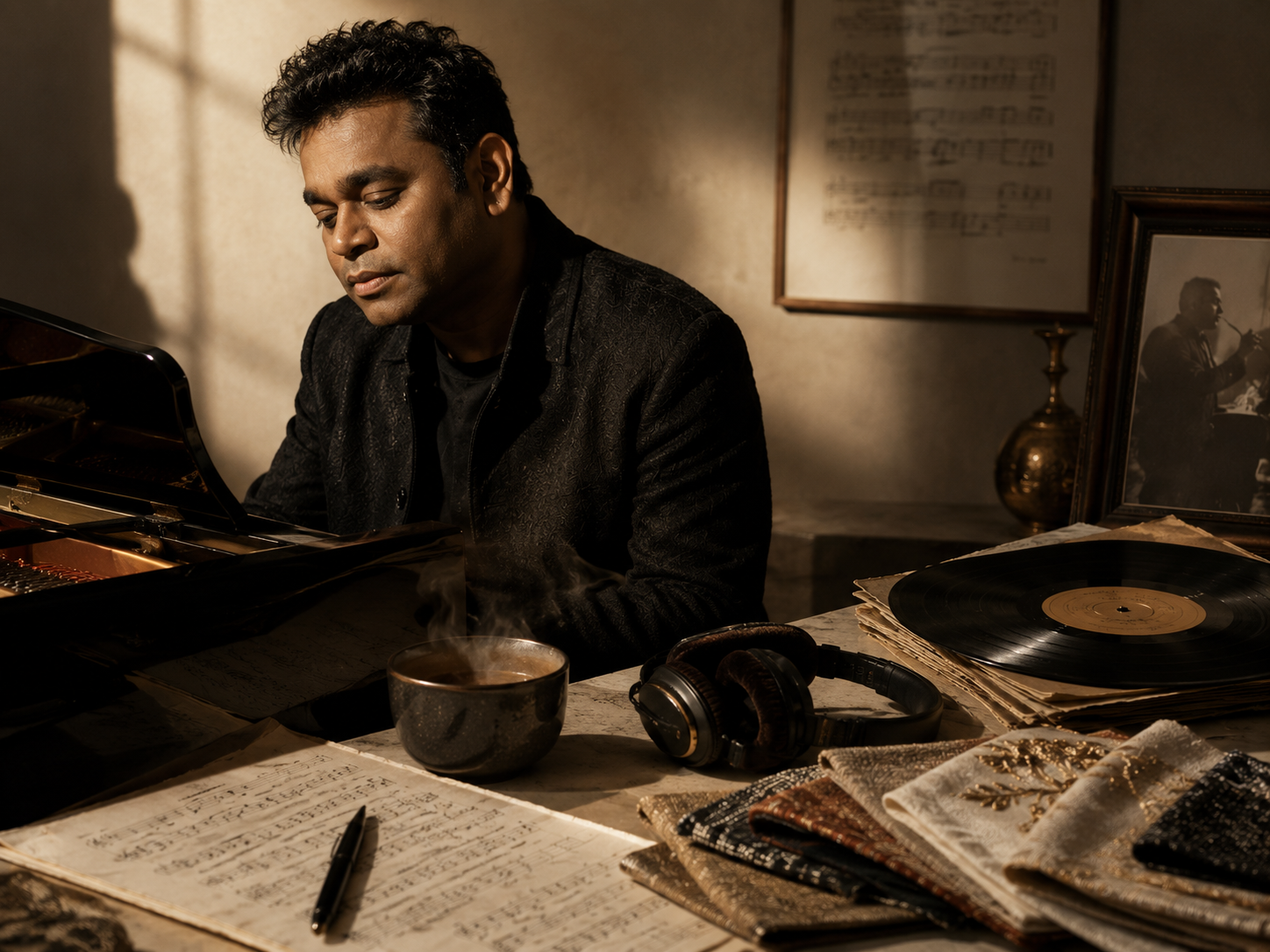
There is a specific image from 2025 that says more about A.R. Rahman's cultural standing than any award ever could: Beyonce, at a Paris fashion show, tapping her foot to a Punjabi track he composed specifically for the runway. At the Louis Vuitton Spring/Summer 2026 menswear show in Paris, Pharrell Williams collaborated with the Oscar and Grammy winning musical genius A.R. Rahman on the track "Yaara Punjabi," which played in the background as models showcased loose pleated trousers, striped coats, and embellished workwear. Many reports suggest the music was an exclusive song created by Rahman specifically for Pharrell Williams. Fashion critic Diet Sabya shared a clip of Beyoncé grooving to the Punjabi music, leaving fans thrilled. This is not a composer being referenced. This is a composer being commissioned, by name, by one of the most powerful figures in global fashion, to define the emotional register of a Paris runway moment.
Paris Fashion Week 2025 kicked off with Pharrell Williams presenting Louis Vuitton's menswear Spring/Summer 2026 collection in front of the Pompidou Centre. The show was all about Indie culture and artistry. From architect Bijoy Jain's Snakes and Ladders-inspired sets to the background score of Rahman's Punjabi track, the cultural vibes were unmistakably Indian. Pharrell Williams and his team embarked on a research journey through New Delhi, Mumbai, and Jodhpur to immerse themselves in the essence of Indian sartorial traditions, capturing an allure that went beyond specific clothing items. Rahman's music wasn't decorated on top of this research. It was the emotional core that the entire visual language was built around. When the world's biggest luxury house wanted to communicate genuine Indian artistry rather than a surface-level aesthetic reference, they didn't reach for a sitar sample library, they commissioned the composer whose work has defined Indian musical identity globally for three decades.
A.R. Rahman made his debut in the Indian music industry with the 1992 Tamil film Roja. In his three-decade-long career, he has composed and produced original scores and songs for more than 175 films across Tamil, Hindi, Telugu, Malayalam, English, Persian, and Mandarin. His compositions have touched the hearts of millions across blockbuster films including Roja, Bombay, Dil Se, Taal, Lagaan, Vande Mataram, Jodhaa Akbar, and Slumdog Millionaire. The pinnacle of his global recognition arrived in 2008 with the success of Slumdog Millionaire, earning him two Academy Awards, two Grammys, a Golden Globe, and a BAFTA. In 1997, Sony Music signed Rahman as its first South Asian artist to commemorate India's 50 years of independence, resulting in the album Vande Mataram, which rekindled patriotic spirit and resonated with Indians globally. Few cultural figures from India have a comparable thirty-year arc of consistent global relevance across multiple eras of how the world consumes Indian art.
Rahman has been speaking about the growth of India's independent music scene and a new platform giving a boost to independent South Asian artists, alongside his work with the all-female Firdaus Orchestra. This matters because it reveals something about why his influence persists across generations rather than fading the way most legacy musicians' relevance does. Rather than only operating within the Bollywood film-score ecosystem that made him famous, Rahman has actively invested in platforms that let the next generation of independent Indian artists, the Karan Aujlas, the Hanumankinds, the Seedhe Mauts of the current desi hip-hop and indie scene, build their own audiences without needing a film studio's blessing first.
In addition to his musical pursuits, Rahman established the KM Music Conservatory in Chennai and the A.R. Rahman Foundation, which provides underprivileged children with music education, while also promoting Western classical music in India. This institutional investment is the real reason Rahman's cultural footprint keeps expanding rather than contracting with age, a fate most legacy musicians eventually face. He didn't just make music people loved. He built the infrastructure for the next several generations of Indian musicians to exist, train, and reach global audiences.
What connects a 1992 Tamil film score to a 2025 Louis Vuitton runway in Paris is a consistent, three decade long demonstration that Indian musical identity, its rhythms, its emotional registers, its specific regional textures doesn't need to be diluted to be globally compelling. It only needs the right hands shaping it. Rahman has been in those hands more consistently, for longer, and across more genuinely global stages than perhaps any other Indian cultural figure alive. The Beyonce moment in Paris wasn't an aberration. It was simply the most visible recent data point in a pattern that's been building since 1992. This same instinct that Indian craft and culture are globally compelling exactly as they are, without dilution is the foundation of what Cop&Drop curates across fashion, jewellery, and lifestyle. The brands worth discovering are the ones with that same confidence.
.
How is A.R. Rahman connected to global fashion in 2025-26? Rahman composed an exclusive Punjabi track titled "Yaara Punjabi" for Pharrell Williams' Louis Vuitton Spring/Summer 2026 menswear show in Paris, with the music defining the cultural tone of the entire presentation.
Rahman won two Academy Awards, two Grammys, a Golden Globe, and a BAFTA for his work on Slumdog Millionaire in 2008, alongside numerous National Film Awards across his Indian film career.
Rahman has composed original scores and songs for more than 175 films across Tamil, Hindi, Telugu, Malayalam, English, Persian, and Mandarin over his three-decade career.
Yes, he remains highly active, working with the all-female Firdaus Orchestra, supporting platforms for independent South Asian artists, and continuing to influence both film scoring and global fashion-music collaborations.
Rahman founded the KM Music Conservatory in Chennai and the A.R. Rahman Foundation, which focuses on providing underprivileged children with access to music education.
His work demonstrates that authentic Indian musical and cultural elements can be globally compelling without dilution, which is why luxury fashion houses, Hollywood productions, and global artists continue to seek genuine collaboration with him decades into his career.