From Historical Flaws to Street Protests: Inside India’s Education Crisis
Writer – Nidhi Dharme
A balanced look at India's education system, covering NEET controversies, textbook revisions, Jantar Mantar protests, political debates, and calls for reform.
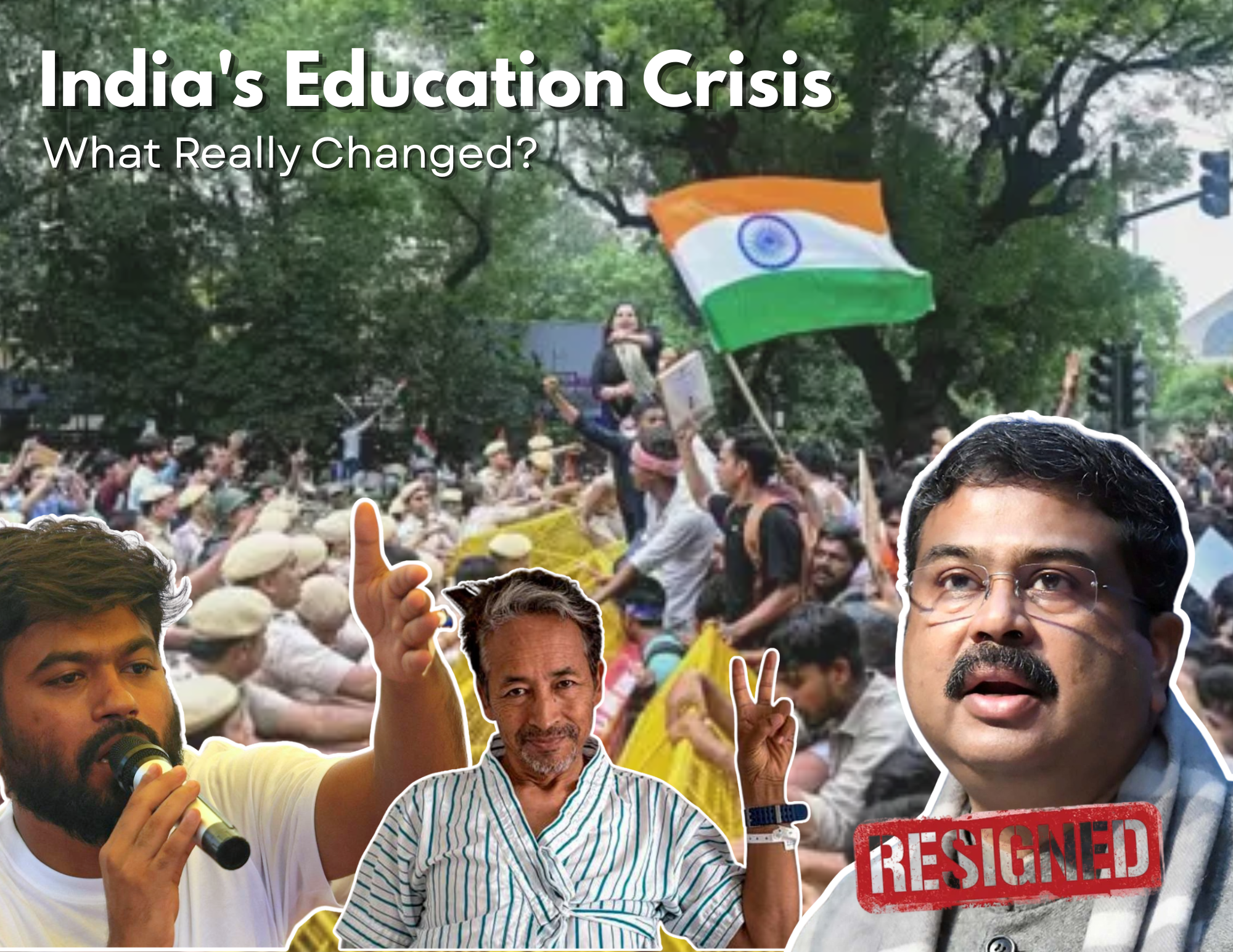
India’s education system has long been one of the most contentious topics in national discourse, serving as both a primary pathway for social mobility and an ongoing battleground for policy debates. Over the past few decades, the sector has seen structural transformations, institutional challenges, and intense ideological debates. Most recently, a perfect storm of judicial observations, paper leak allegations in competitive examinations, online viral movements, and weeks of street protests at Delhi's Jantar Mantar brought the nation’s academic administrative machinery under unprecedented scrutiny.
Understanding how a technical dispute over examination integrity turned into a massive political standoff requires looking back at the chronic flaws embedded in the system before tracing the recent cascade of public outrage and political shifts.
Long before recent headlines, the Indian education framework faced systemic criticisms spanning academic quality, administrative opacity, and political bias. Primary among these was an over reliance on rote learning, where national and state board examinations rewarded memorization over critical thinking and practical understanding. This setup fostered a multi billion dollar private coaching industry, turning cities like Kota into high pressure test preparation hubs while public schooling infrastructure struggled with teacher shortages and unequal resource distribution.
The debate over curriculum content was equally contentious. Social science and history textbooks published by the National Council of Educational Research and Training were frequent points of political friction. Critics often argued that pre-2014 textbooks favored a specific ideological narrative, giving disproportionate weight to certain dynasties while glossing over regional histories and indigenous empires. Defenders maintained that the curriculum offered a balanced, secular perspective essential for a diverse country. Despite sporadic policy interventions, fundamental issues such as state level paper leaks and administrative inertia remained unresolved for decades.
Following the political shift in 2014, the National Democratic Alliance government introduced major policy changes, culminating in the rollout of the National Education Policy in 2020. The policy sought to replace traditional learning models with flexible, skill based education. However, parallel efforts by NCERT to rationalize school textbooks after the pandemic generated intense public debate.
The most controversial changes included removing or reducing dedicated chapters on the Mughal Empire, the Delhi Sultanate, references to social movements, and certain historical conflict events. Supporters of the government argued that these revisions were necessary to streamline heavy syllabi, eliminate ideological biases, and highlight long-neglected periods of Indian history and heritage. Conversely, opposition parties, academics, and critics viewed the removals as an attempt to rewrite history and erase historical periods to suit a specific political narrative. During this same period, the government expanded centralized testing under bodies like the National Testing Agency to unify admissions nationwide, setting up the framework for future administrative challenges.
The immediate catalyst for recent student led mobilizations arose from an unexpected moment in court. During a legal proceeding regarding fraudulent qualifications and institutional corruption, judicial remarks comparing opportunistic elements in the system to parasites or cockroaches were widely circulated online. Although the observations targeted fake degree holders and systemic abusers, many job seeking graduates and competitive exam aspirants perceived the phrasing as dismissive of youth struggling with high unemployment and delayed recruitment drives.
Social media strategist and returnee graduate Abhijit Dipke capitalized on this widespread frustration. Choosing satire as a form of protest, Dipke adopted the term and founded the Cockroach Janata Party online. What began as a digital campaign mocking institutional apathy quickly struck a chord with millions of students facing exam delays, cancellations, and paper leaks. CJP evolved into an active platform aggregating student grievances, converting digital memes into real-world youth activism.
The online outrage escalated when severe irregularities, grace mark allocations, and leaked question papers surfaced surrounding the NEET-UG medical entrance exam. The scandal affected millions of students who had spent years preparing for a limited number of medical seats. Digital platforms erupted into heated debates. One side demanded total administrative accountability, independent audits, and an overhaul of the testing agency, while defenders of the system argued that isolated malpractices were being blown out of proportion to discredit national institutions.
Transitioning from online commentary to direct action, CJP organized physical demonstrations, mobilizing thousands of aspirants and parents to assemble at Delhi's Jantar Mantar. Protesters set up camp to demand the cancellation of compromised exams, compensation for affected families, and structural reforms in how national competitive tests are conducted.
As the sit-in at Jantar Mantar stretched over several weeks, the character of the protest naturally shifted. Opposition parties and political commentators began offering explicit support to the student movement, which led government supporters to label the demonstration as politically motivated, anti-establishment, or anti-national. Critics claimed that genuine student grievances were being hijacked by political groups to build an anti-government narrative.
To keep the focus on systematic reform and maintain public trust, protest organizers sought to align with respected, non-partisan public figures. Educator and innovator Sonam Wangchuk joined the cause, lending his voice and participating in a fast to highlight the plight of the nation's youth. His involvement brought renewed media visibility to the movement. However, as police barricades, detainments, and clashes with authorities escalated during marches toward Parliament, the standoff became increasingly polarized in the public eye.
After weeks of continuous protests, intense media coverage, and growing political pressure, the government moved to address the administrative crisis. Union Education Minister Dharmendra Pradhan stepped down from his position, taking moral responsibility for the testing failures and the disruption caused to millions of candidates.
But do you think it’s fair for him to step down from his position as paper leaks were done by other people and not him.
In his place, senior minister Pralhad Joshi was given charge of the Ministry of Education to stabilize the situation, oversee thorough investigations, and rebuild public trust in national entrance tests. Following formal dialogues and government assurances regarding systemic overhauls, the 36-day protest at Jantar Mantar was officially called off. The transition marked a rare moment where youth driven digital activism directly prompted top level political accountability, leaving the nation's education system at a crucial crossroads of promised reform.
At Cop&Drop, our goal extends beyond tracking fashion trends and urban culture, we document the shifting ideas, voices, and movements shaping today’s youth landscape. The rise of the Cockroach Janata Party and the NEET demonstrations reflect a broader cultural movement, one where digital fluency, satire, and street level activism converge to hold traditional institutions accountable. Understanding these shifts is essential for any platform committed to chronicling modern Indian youth culture, as the demand for transparency in education directly impacts the aspirations, mental health, and future of an entire generation.
The end of the Jantar Mantar sit-in marks a significant victory for student activists, but the broader discussion around systemic fairness in Indian education is far from over. As the government and student representatives prepare for further dialogue on comprehensive entrance reforms, attention is turning toward other long-standing policy debates.
What do you think? Now that the CJP has demonstrated its ability to mobilize youth and demand institutional accountability, should they also expand their platform to protest for the removal or restructuring of reservations in competitive exams, or should they strictly stick to exam integrity and anti leak reforms? Share your thoughts on your stories and don't forget to tag @copdrop.in