The Rakhi That Still Sits in a Drawer Somewhere — A Letter to Siblings This Raksha Bandhan 2026
Aug 25, 2026
Writer – Nidhi Dharme
Raksha Bandhan 2026 is on August 28. But before the thali comes out and the mithai gets ordered, here's everything the festival is actually about the memories nobody posts about.
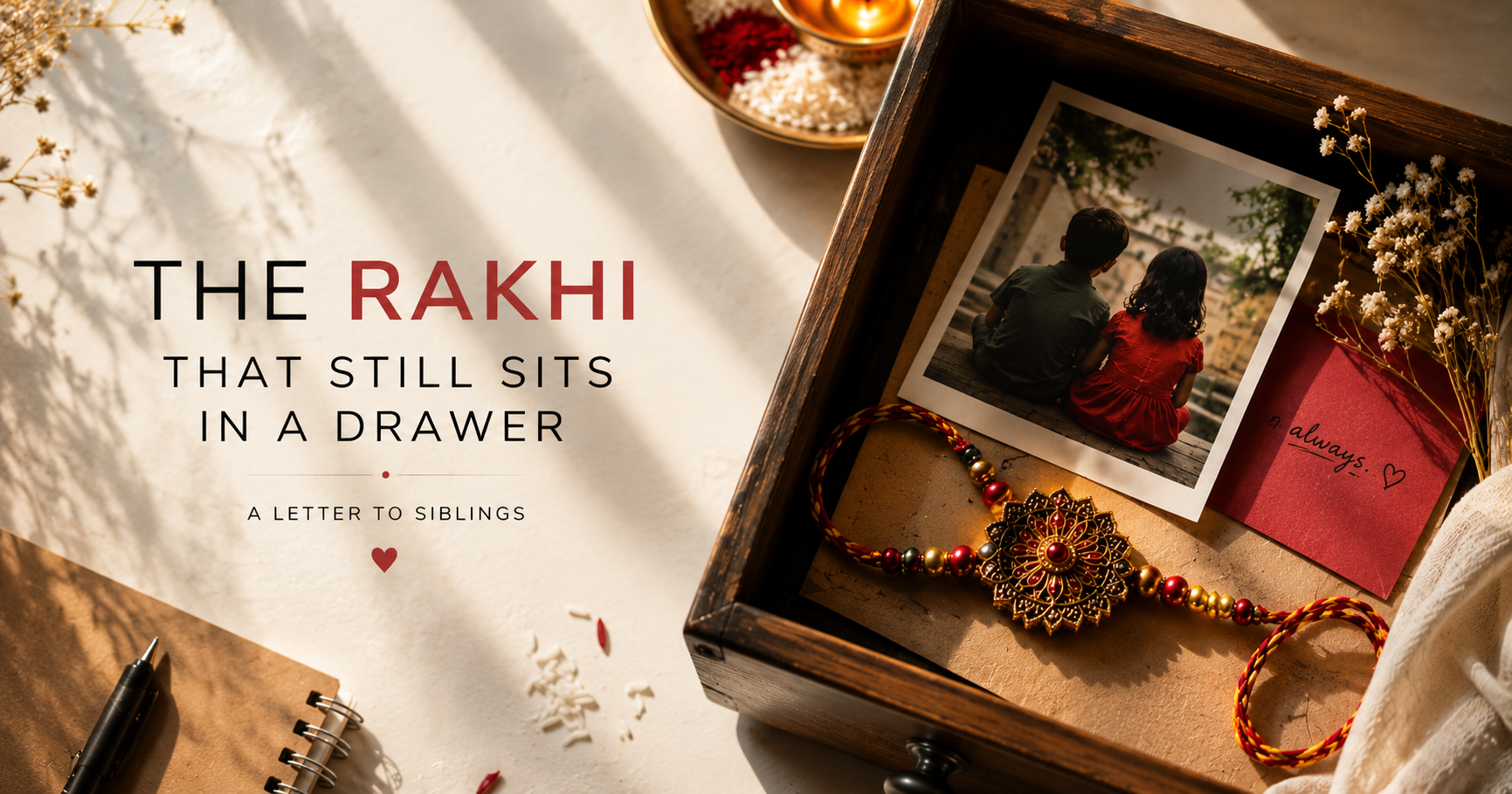
Somewhere in your home right now there is a rakhi from a previous year that never got thrown away. Maybe it's in a kitchen drawer under rubber bands and old pens. Maybe it's folded into a corner of a cupboard that only gets opened twice a year. Maybe it's still on a wrist, worn down to a faded thread that the person wearing it hasn't untied because they forget it's there until Raksha Bandhan comes around again and suddenly they remember exactly when it was tied and exactly what was happening that year.
That rakhi is not junk. That rakhi is time.
Every family's Raksha Bandhan morning has its own rhythm. But the shape of it is almost always the same.
Someone woke up earlier than necessary. The thali was assembled, the little diya, the rice, the rakhi, the mithai already arranged with an attention to detail that would seem excessive for anything else but for this felt completely right. The house smelled different. Not the incense alone. Something about that combination of August monsoon air coming through the windows and the specific sweetness of whatever the kitchen was producing before 9 AM.
The brother, regardless of age, managed to look exactly like he didn't know what to do with his hands. The sister, regardless of age, took longer than expected to tie the knot, not because she didn't know how but because the moment kept feeling like it deserved more time than it was getting.
Then the aarti. Then the tilak. Then the rakhi around the wrist. Then the gift, which was never quite the right thing but was always the exactly right thing anyway.
Then breakfast. And then the day continued exactly as days do, carrying that thread on one wrist.
The photographs from Raksha Bandhan always show the moment of the tying. The smiles. The thali. The finished Rakhi looked bright against the skin. These photographs are real and they're beautiful and they're also not the whole story.
What the photographs don't show is the argument from the previous week that nobody mentions today. The phase where calling became. less frequent because life got busy in ways nobody planned for. The specific texture of missing someone who is geographically close but somehow occupies less of your daily life than they used to. The strange feeling of celebrating a bond with the full ceremony of flowers and sweets and a sacred thread while being unable to say the direct version of what you actually feel because the direct version has never been how siblings communicate, it's always been through the side door, through the joke, through the "remember when," through the showing up without being asked.
Ask anyone whose siblings are in a different city or a different country what Raksha Bandhan feels like and the answer is almost always the same.
The envelope arrives a few days early because the post can't be trusted entirely. Or it doesn't arrive and there's a video call instead where the sister holds up the rakhi to the camera and the brother extends his wrist toward his own camera in a different time zone and the whole thing is technically functional and also completely insufficient and both of them know it and nobody says so.
Canada's Indian community celebrates with video-call rituals that have become increasingly common when physical travel is not possible. This is true of Canada. It is true of Dubai and Singapore and London and Sydney and every city that has absorbed an Indian family member who left for work or study or life and stayed.
The distance doesn't make the festival less real. It makes it more concentrated somehow. Everything that was casual and assumed when you lived in the same city becomes deliberate and valued when you don't. The envelope in the mail is not just a rakhi. It's the proof of keeping up a tradition across time zones and courier services and adult lives that got unexpectedly complicated.
There is a specific thing brothers do on Raksha Bandhan that has never been captured adequately in any film or advertisement.
After the ceremony, at some point in the day, when nobody is paying particular attention, they look at the rakhi on their wrist. Not for long. Just for a moment. It's not sentimentality exactly. It's something more like recalibration, a brief, private acknowledgment of where they came from and who was there at the beginning of the story.
The gift was probably not what the sister wanted. The promise was made in the general language that promises at ceremonies always use. But the thread is real and the moment of looking at it is real and what it contains is real even if it never gets articulated.
This is how siblings operate. Everything important is conveyed through the periphery.
Raksha Bandhan has attracted its share of commentary over the years about what it means, what it should mean, whether the protection narrative is outdated, whether the ceremony needs updating for contemporary family structures. All of that commentary exists for good reasons and none of it is wrong exactly.
A sister and brother are in the same room. Or connected by a screen. Or separated by distance with a packet somewhere in transit between them. And there is a thread. And there is a tilak. And there is mithai that is slightly too sweet. And there is a moment where time does what it very rarely does, slows down enough to be noticed.
That's it. That's the whole festival.
A man's tie with his sister is very close. The two have grown up together, at an age when there is no distinction made between the sexes. And later, when the sister marries, the brother is seen as her main protector for when her father has died to whom else can she turn if there is trouble in her conjugal household.
The scholarship says protection. The lived version says something more like: I know where you came from. I was there. I remember the version of you that existed before you had to explain yourself to the world. That version is safe with me.
That's what the thread carries. That's why it doesn't get thrown away.
This Raksha Bandhan, before the thali, before the muhurat window closes, before the gift is handed over and the photograph is taken and the day continues, take a moment that the camera doesn't need to see.
Just the thread. Just the wrist. Just the two of you, wherever you are, whatever the distance, whatever the year has held between you.
The bond of protection has never really been about protection. It's about the person who knows your whole story and loves you anyway.
At Cop&Drop, we believe the most meaningful gifts aren't found on a homepage algorithm. They're made by hand, with intention, by founders who understand what it means to make something for a specific person at a specific moment. This Rakhi, find a gift that feels like you actually thought about it.